Meter alone
Broadcasts, but goes nowhere
The telegram exists — every few seconds, on the meter's own schedule — but without a listener nearby, it's just RF in the room. No history, no alerts, no bill.
Compatible meters already broadcast a telegram every few seconds — that's the easy part. LegitFix is the local concentrator that catches it, decodes it, and streams it to LegitOS the moment it happens. No batching, no per-meter cellular chip, no estimates.
A wireless M-Bus meter isn't a dumb AMR device you have to walk up to — it already broadcasts on its own schedule, unprompted. What's usually missing is the second half: an always-on path from that broadcast to a system that can bill, alert, and show a current balance. That's the piece LegitFix is.
The telegram exists — every few seconds, on the meter's own schedule — but without a listener nearby, it's just RF in the room. No history, no alerts, no bill.
LegitFix listens locally, decodes the full telegram, and forwards a computed reading over 4G the moment it arrives. The meter's own AMR-grade radio becomes an AMI-grade network.
For a submetering operator billing hundreds of units per building, cellular-embedded meters put a paid connection inside every single unit. LegitFix puts one 4G connection per concentrator instead — often just one per building — and lets every meter reach it for free over local RF.
"ID" here means whatever ties one meter to one network: a SIM for NB-IoT, a DevEUI/AppKey pair for LoRaWAN. Different mechanism, same result — a paid, per-device relationship reproduced across every meter.
Pump rooms, parking garages, machine rooms, buildings with reinforced concrete slabs and fire doors — the meter itself often has no line of sight to a cell tower or LPWAN gateway there. LegitFix's radio hop only has to cross the client's own walls, not reach outside the building, so it can sit wherever 4G signal is adequate — even if the meters around it are buried deep inside the structure.
| Constraint | NB-IoT / LoRaWAN | Wired M-Bus + Ethernet | LegitFix |
|---|---|---|---|
| Latency | Batches to save battery/bandwidth — hours of delay | ~10s, if nothing in the pipeline bottlenecks | Event-driven streaming, no batching required |
| Provisioning | DevEUI/AppKey and vendor onboarding per device | Rewiring the meter module + recognized gateway | Plug-and-play — transmits as soon as it's installed |
| Physical penetration | Weak through reinforced concrete and metal | Requires new wiring through the same structures | Sub-GHz RF penetrates concrete and metal reliably |
| Connectivity cost | One paid data line per meter | N/A — wired, but material + labor cost per run | One data line per building, meters read for free locally |
| Switching provider | SIM is sealed inside an IP68 meter — not field-replaceable | Re-terminating wiring at the gateway | Swap the concentrator; meters don't know or care |
Most connectivity lock-in isn't a contract clause, it's physics. A cellular meter's SIM ships pre-provisioned to one carrier, and the meter body is sealed to IP68 for water submersion — so that SIM can't be swapped without breaking the enclosure's own rating. The dependency is permanent by design, not by choice.
Carrier profile (or LoRaWAN join keys) is provisioned at the factory and sealed inside an IP68 body. Changing provider means reflashing or replacing hardware — not viable across an installed fleet without breaking watertightness.
The meter speaks an open OMS/wM-Bus protocol — it broadcasts without knowing or caring who's listening. The only component tied to a carrier is the external, wall-mounted concentrator, which can be replaced without touching a single meter.
LegitFix isn't the meter manufacturer's own gateway — it's a local, protocol-native concentrator that sits between the meter and LegitOS. It decrypts the full radio telegram on-site and forwards only a computed reading upstream.
Compatible meters send a telegram at their own native interval — no provisioning, no DevEUI or AppKey, no vendor-specific decoder required.
Every telegram is decrypted and analyzed on the concentrator. Without consumption, only an hourly heartbeat goes out.
Readings reach LegitOS over MQTT roughly 10 seconds after the meter's own telegram. Pricing rules turn it into an automatic invoice.
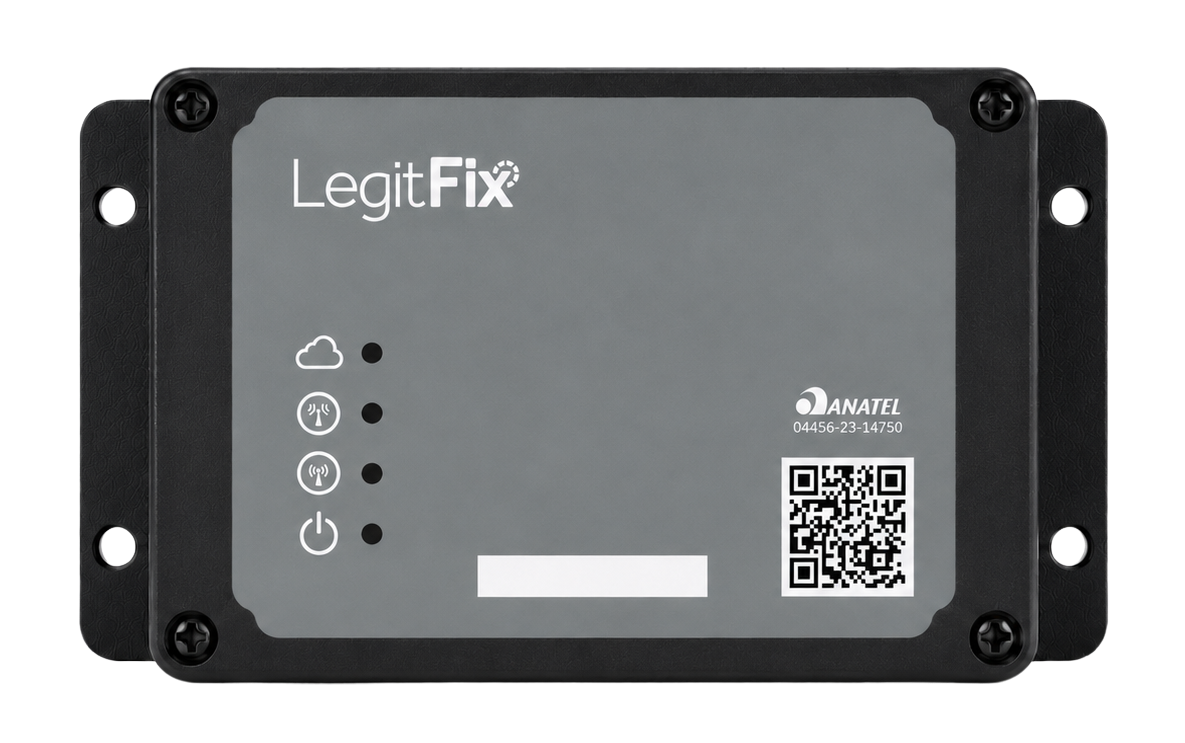
| Enclosure | Black polycarbonate, wall-mount |
| Dimensions | 115 × 90 × 55 mm (body) |
| Certification | ANATEL 04456-23-14750 |
| Indicators | 4 status LEDs — cloud, signal, RF, power |
| Data layer | OMS-compliant (EN 13757-3) |
| Radio — 433/434 MHz | Wireless M-Bus, the OMS-specified band for markets outside Europe where 868 MHz isn't the local standard: Brazil (proven at scale, 400+ units live), Australia, and the Middle East |
| Radio — 868 MHz | Europe — the actual wM-Bus/OMS standard band, same EN 13757-3 frame and application layer |
| Radio — 902–928 MHz | North America — 915 MHz nominal, FCC Part 15.247/15.249 unlicensed band |
| Radio — 2.4 GHz (BLE) | Some meters use Bluetooth Low Energy instead of wireless M-Bus — LegitFix reads both natively. |
| Payload | Encrypted; decrypted and computed locally by LegitFix |
| Transmission logic | Event-driven on consumption + guaranteed hourly heartbeat |
| Capacity | Up to 500 meters per unit |
| Uplink | MQTT over 4G LTE / Cat-M |
| Provisioning | None required — no DevEUI/AppKey, no vendor-specific decoder |
302 smart meters across 370,650 acres, covered by 5 LegitFix units.
Read case study →A local LegitFix concentrator covers every consumption point in a facility where cellular and LPWAN signal essentially don't reach.
Talk to our team →Per-vessel water supply metered and billed automatically, with flow rate calculated for the full duration of each event.
Talk to our team →Tell us about your buildings and meter park. We'll show how LegitFix turns existing AMR radios into an AMI network.